

Support
Get help with setting up and using AirSuite sensors and software.
Placement Guide
How many sensors do I need, and where should I put them?
Not sure about the number of AirSuite sensors you need, or the best places to mount them? We’ve got you! Read on for everything you need to know about this topic.
How many AirSuite Sensors do I need?
We recommend an average of one sensor for every 200m²/2,000ft² in an open space where air mixes continuously, with at least one sensor in each room. However, there are lots of different sorts of buildings, and we assess them on a case-by-case basis.
Several factors impact sensor coverage:
- Do you have doors that open regularly - for example a busy foyer or the entrance at an airport?
- Do you have high ceilings?
- How is your space being used?
- What variables impact your air quality and movement?
Where should we mount sensors in our commercial building?
In commercial buildings, consider where:
- people gather;
- you want to measure light or noise levels;
- there may be increased risk of exposure to chemicals or fumes (e.g. a lab environment);
- there may be differences in airflow in large, open spaces. For example, due to nearby windows/doors, or HVAC system vents.
In offices and other workplaces, we advise mounting a sensor in each meeting room.
I’m measuring the air quality in a home. Which rooms should I place them in?
In homes, we advise mounting your AirSuite Sensors in at least one bedroom and one living area.
Our hospital/aged care facility rooms are occupied 24/7. How do we manage this - especially the CO₂ readings?
In a room that’s constantly occupied - and may be unventilated - constant high CO₂ levels can cause sensor drift. Talk to us about the best way to manage this (we can disable the automatic baseline calibration feature and you can manually calibrate the sensor as needed instead).
What other spaces benefit from AirSuite Sensors?
Our sensors are designed to be versatile and used in a variety of spaces - residential, commercial, and everything in between! Our customers are using sensors everywhere from classrooms and playcentres, to public spaces like art galleries, museums, libraries, and courthouses, where many people congregate.
Where should sensors be placed in each room?
Head height
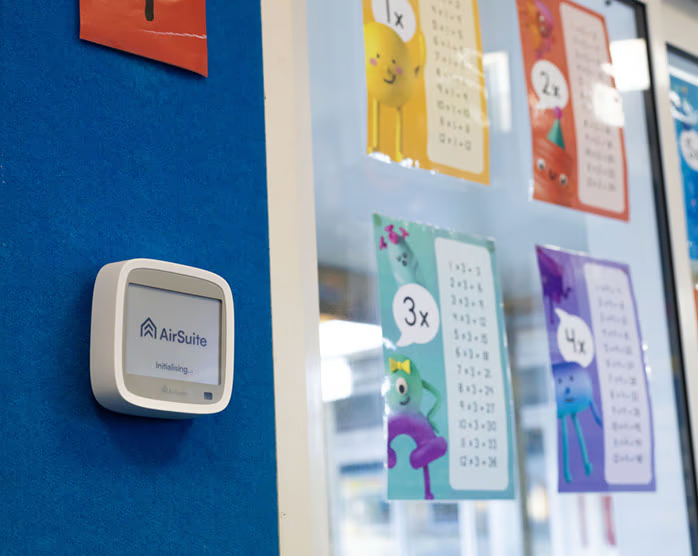
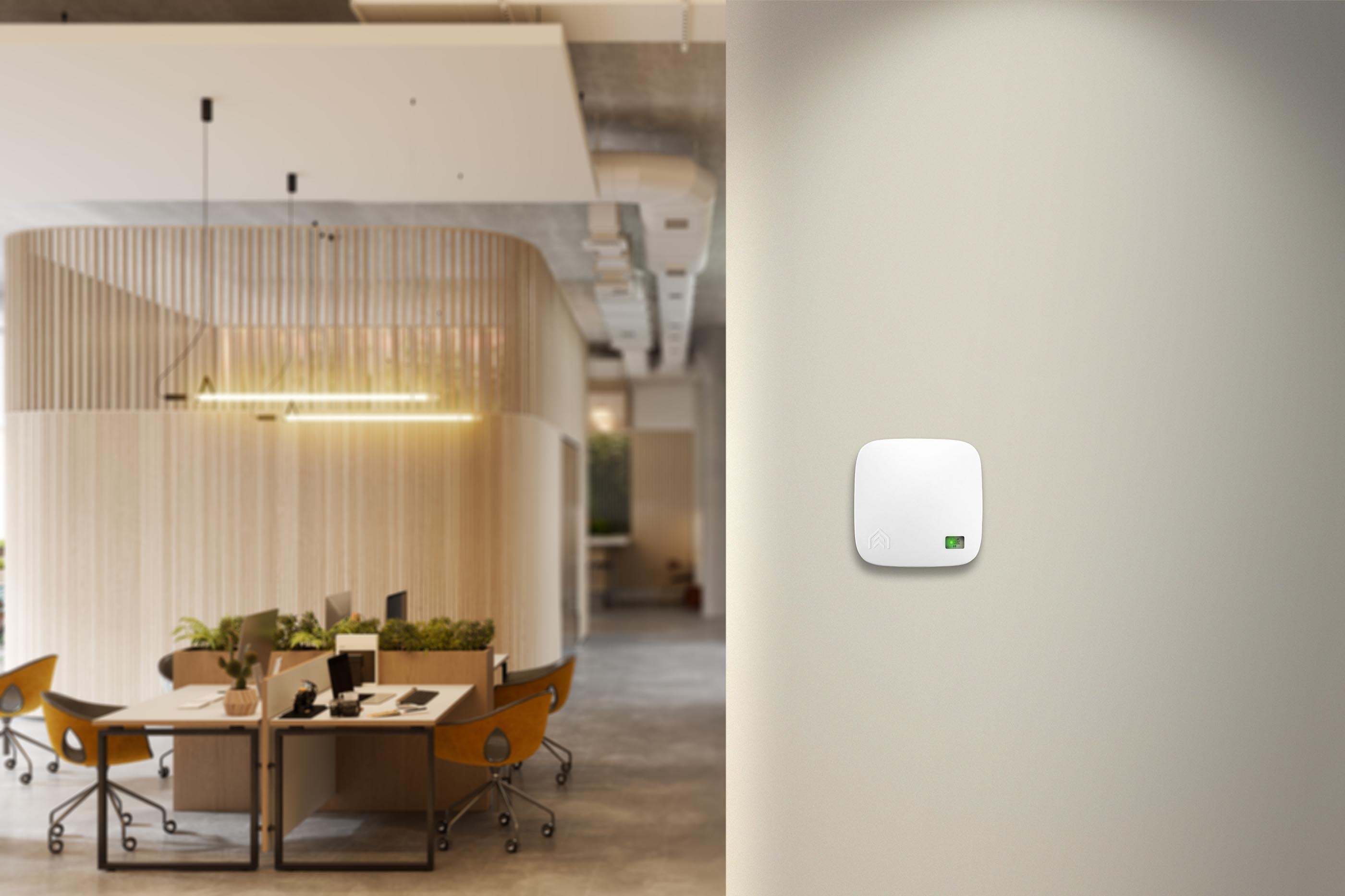
Place your sensor(s) on the wall, at head height for the people who will use the space. For most environments we recommend a ‘head height’ of 1.5m to 1.8m. Consider regulation that applies to your industry: for example, in New Zealand, the temperature in Early Childhood Centres must be monitored at 500mm (0.5m) above the floor, which most closely matches the temperature felt by young children.
Avoid heat sources and direct sunlight
Don’t place your sensor above a stove, kettle, or other heat source as it is likely to offset readings. And avoid direct sunlight as this results in reading spikes.
Inside and away from dust
Our devices are designed to measure indoor air quality, so keep them inside and out of dusty spaces. You don’t lose the outdoor picture by doing that - we also measure the outdoor conditions for you automatically, based on the weather reports at each sensor’s location. If you’re considering mounting a sensor outside anyway, see “Can we install a sensor outside?” below.
Can we install a sensor outside?
It’s not something we officially support. AirSuite sensors are built to measure indoor air quality: they are not waterproof, dust-proof or IP-rated, so an outdoor mounting sits outside what the hardware is designed for.
Some customers do it anyway, to get a baseline of outdoor conditions to compare their indoor readings against - which shows how well the building itself is performing. Where they do, the sensor is fully covered so the weather can’t reach it. Dunedin City Council, for example, fixed one of their eleven monitors outside as a reference point for the ten inside their passive housing units.
Usually it isn’t necessary. The AirSuite Portal already shows temperature and humidity from a local weather service alongside your indoor data, which is enough for most comparisons. An outdoor sensor is only really worth considering if you need highly localised readings and scientific accuracy - and if you’re thinking about it, talk to us first.
Are AirSuite devices appropriate for our factory?
We’re happy to visit your site to scope out the space. Some factory conditions, such as excess dust, can damage devices, but we welcome a conversation to see if there is a workaround we can arrange for you.
I’m concerned about children tampering with sensors.
We get it - it’s always a risk with inquisitive young minds!
We will provide the type of mount you need based on your circumstances and who uses your spaces. We have a tamper-proof wall mount available, which can be provided as an add-on for your existing or new devices.
I’m keen to keep sensors out of the way - can I put them high on the wall, or ceiling?
Since heat rises, in most buildings there are usually a few degrees Celsius difference between floor and ceiling temperatures. To ensure accurate measurements, we don’t advise mounting sensors on the ceiling or high on a wall. However, other sensors such as CO₂, light, and sound will not be significantly impacted by placement on the ceiling, and some of our customers are taking this approach to keep them out of the way.
What factors impact how many sensors I need?
AirSuite devices take in air through their vent and measure CO₂ levels in the sample. If there’s good ventilation, plenty of air will pass through the device. If the air is quite still - with limited or no movement - this will impact the device’s ability to take an accurate reading.
Doors, walls, or other physical barriers which divide the room makes air sampling more difficult. An example of this is office cubicles. In this case, you may want to purchase more monitors to check air quality in several areas or use one sensor and move it around.
I’m a large commercial client. Can AirSuite come and scope out my space?
Yes, we can do that. If you’re unsure how many devices you need, we can come and investigate your space. It’s something we do a lot for clients with large work areas.
But it’s not mandatory for us to come and visit you - usually all we need is a quick conversation. We can talk about the number of sensors you need and supply them for you.
If you find the readings are not enough and you discover you need a few more, we are flexible.
I’m not sure if I’ve fixed the sensor in the right place. What can I do?
Feel free to take a photo of the sensor, with enough context so we can see its position on the wall, and send it to us. We can check it for you and let you know.
I’ve fixed my sensor in a particular spot but I want to move it. Is that ok?
Absolutely! This is one of the awesome AirSuite advantages.
All AirSuite sensors come equipped with a built-in long-life or rechargeable battery, so they’ll even keep working while you’re moving them around.
You can move your LTE sensors just about anywhere, and they’ll keep working automatically.
If you have Wi-Fi devices, just make sure they remain within range of your Wi-Fi network, or you’ll need to set them up again on a new network through the mobile app.
Sensors don’t need to be mounted to your wall with screws - each sensor comes with a handy pack of 3M mounting strips.
Top tip: In our office, we attach 3M strips to the mount rather than the device. This lets us stick the mount to the wall, and if we want to move the sensor, we twist it off its mount and put it in another space. This new location could even be a desk where it doesn’t need to be stuck to the surface. AirSuite Sensors are designed to be versatile and portable.
To recap:
- The number of AirSuite Sensors you need depends on several factors including the type of space (residential/commercial/educational facility etc), how it’s used, and the level of ventilation.
- We recommend an average of one sensor for every 200m²/2,000ft² in an open space where air mixes continuously.
- We can scope out your space if you’re unsure.
Alerts
- Configure alert thresholds
- Email Notifications
- Manage Alerts
- Mobile App Notifications
- Our Recommendations
Connectivity
- Battery Life
- LTE Coverage Guide
- Over-the-air Updates
- Troubleshoot Inactive LTE devices
- Troubleshoot Inactive Wi-Fi devices
- Wi-Fi Access Point Compatibility
- Wi-Fi or LTE?
Manage Access
Sensors
- AirSuite Glance display
- CO₂ Calibration
- Deep dive: Particulate Matter
- Deep dive: VOCs
- Download user manuals
- Getting started with AirSuite Glance LTE
- Measurement & Reporting Intervals
- Placement Guide