
Key benefits
Lower your carbon emissions
More efficient buildings make for a more sustainable future. The energy a building does not waste is the cheapest carbon reduction available to any organisation — and the least disruptive to the people using it.
AirSuite measures how your spaces are actually performing, so emissions reduction can be targeted at real waste rather than spread thinly across a portfolio.

The problem
Buildings are a large share of global emissions, and much of it is waste
Reducing a building’s carbon footprint is usually framed as a capital problem: new equipment, new glazing, new controls. But a significant share of the energy a building consumes is simply spent conditioning space that nobody is using, at times nobody needs it.
That waste is invisible in a utility bill. Consumption arrives as a single monthly figure for a whole site, which is far too coarse to tell you which floors, rooms or hours are responsible — and therefore far too coarse to tell you what to change first.
Reporting obligations are moving in the opposite direction. Organisations increasingly need to evidence emissions performance rather than assert it, which requires a measurement record that holds up to scrutiny.
The evidence
The scale of the opportunity
How AirSuite helps
Find the waste before you spend capital on it

Locate the waste
Combining air quality monitoring with analytics uncovers the patterns a meter cannot: heating and cooling running out of hours, zones fighting each other, and spaces conditioned far beyond what their occupancy warrants.

Cut load without cutting comfort
Light, heating, humidity and occupancy data together show where consumption can come down with no effect on the people in the building — the reductions that stick, because nobody has a reason to reverse them.

Evidence the reduction
Because monitors stay in place, the same record that identified the opportunity also demonstrates the outcome, and supports the reporting and certification work that follows.
Emissions Insights
How buildings contribute to climate change

Where it leads
From measurement to a defensible reduction
Baseline your portfolio
Start with the buildings you suspect are worst. A short measurement period is usually enough to rank them honestly, and to stop capital being spent on the site that merely complains loudest.
Report with confidence
Export the underlying data for sustainability reporting, or use it alongside a NABERS rating. Our consulting team can help turn a monitoring record into the analysis your reporting requires.
In practice
Checking that a low-carbon building performs as specified
Dunedin City Council owns 941 community housing units, ten of them built to passive standards on School Street. A nine or ten Homestar rating adds around a quarter to the build cost, so before committing further capital the council wanted evidence that the premium delivers what it promises.
Eleven monitors do that work — one inside each unit and one outdoors as a reference, kept fully covered: the sensors are built for indoor air, so an outdoor mounting is not a deployment we officially support. If the units perform as designed, their temperature, humidity and CO₂ stay steady through a Dunedin winter while the outdoor sensor swings. The energy those units do not use is the carbon they do not emit, and the council can now show it with a measurement record rather than a specification.
Where the council is confirming that capital was well spent, a New Zealand government agency used room-level data to find a reduction that needed no capital at all: heating and cooling running through evenings, weekends and public holidays across a 300-monitor portfolio, and corrected schedules and set points worth roughly 12% of its energy costs.
Questions
Emissions and sustainable buildings
Does AirSuite measure carbon emissions directly?
No. AirSuite measures the indoor conditions and occupancy patterns that drive energy consumption, which is what lets you find and remove waste. It is a tool for reducing emissions at source rather than an emissions accounting platform.
Is CO₂ monitoring the same as carbon reporting?
They are easily confused but quite different. The CO₂ an AirSuite monitor measures is the carbon dioxide people exhale into a room, which indicates how well that space is ventilated. Carbon reporting concerns emissions produced by energy use. Ventilation data helps reduce the latter by showing where conditioning is unnecessary.
How does this fit with a NABERS rating?
AirSuite automates the data collection required for NABERS Indoor Environment assessments, and the Monitor Portal includes a calculator to estimate your rating before assessment. If you are pursuing NABERS Energy as well, our team can talk you through it.
Can the data feed our existing reporting tools?
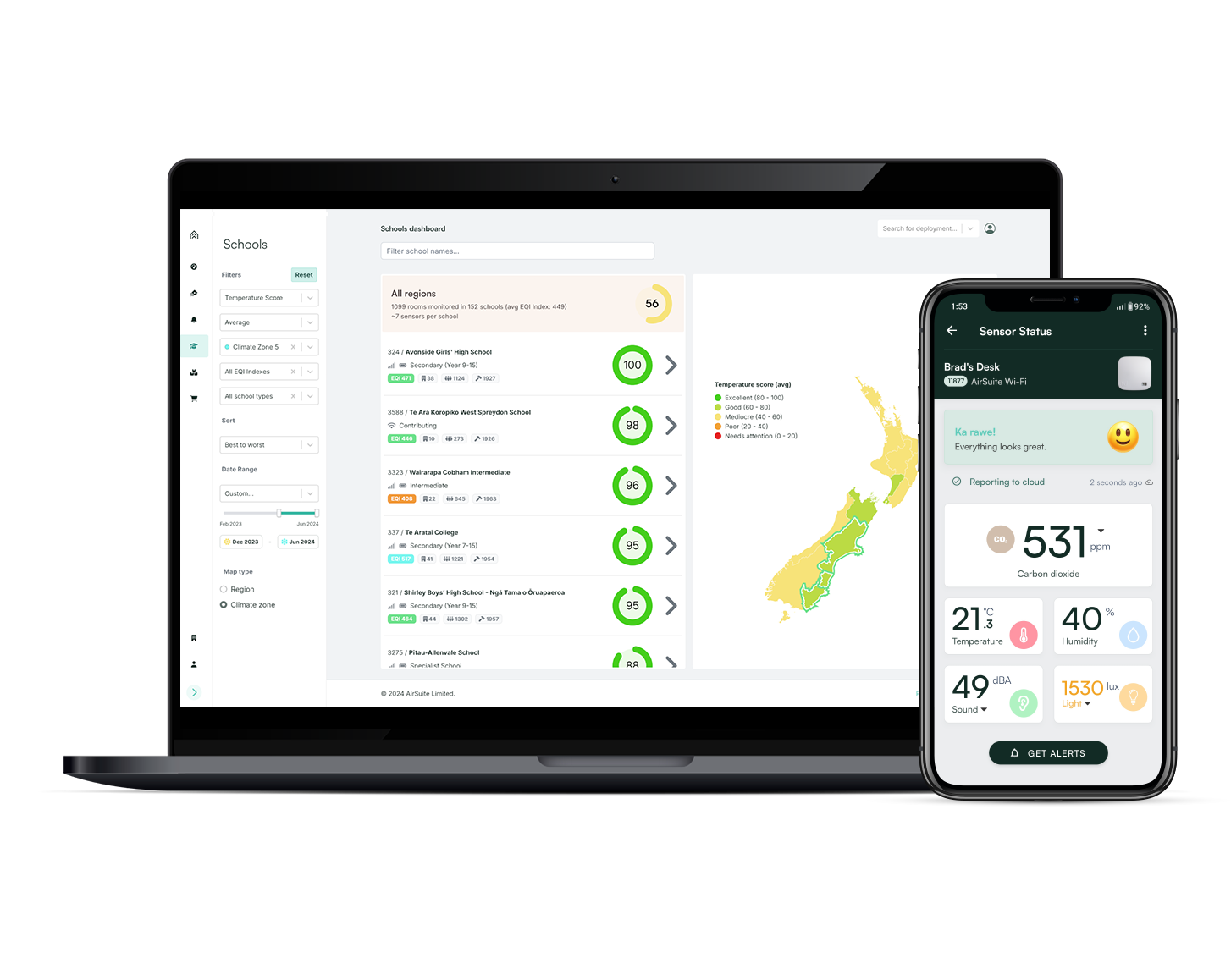
Yes. Data can be exported from the Monitor Portal, and our API integrates AirSuite monitoring directly with building management systems and other platforms.
What does a deployment involve?
Monitors connect over 4G/LTE-M or Wi-Fi and install in under a minute without tools, so a building can be instrumented without cabling, downtime or IT project work.
Where should we start?
Usually with the buildings that cost the most to run or draw the most complaints. Our consulting team can help you scope a first deployment that will answer a specific question rather than simply gathering data.
Ready when you are
Let’s talk about how AirSuite™ can deliver real indoor outcomes for your organisation today