

Te Pūkenga operates across a network of 16 tertiary and trades campuses around New Zealand, each with unique environments — from classrooms and laboratories to high-risk engineering and beauty training spaces. In the past, individual campuses (business units) such as Wintec relied on external consultants for air quality and environmental testing. Each visit could cost up to $13,000–$14,000 for just two weeks of sampling at a single site, and provided a limited, point-in-time snapshot that failed to reflect the variety of conditions across teaching cycles or seasons.
The business case for a smarter, longer-term approach
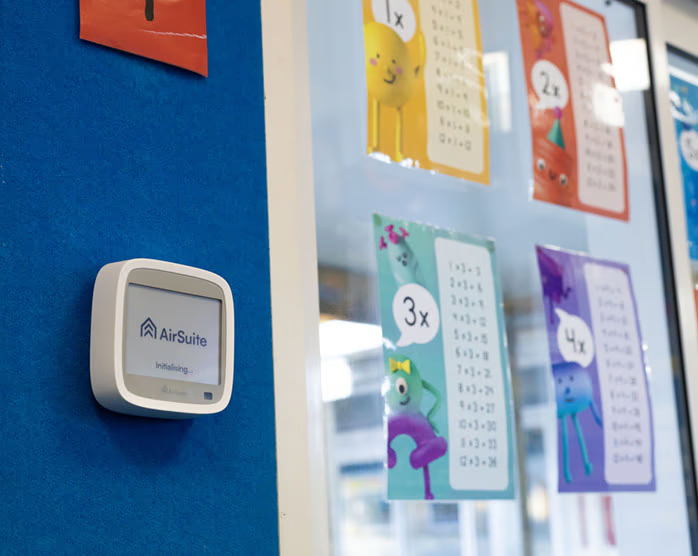
In 2022, the Health, Safety & Wellbeing team proposed a proactive, data-driven alternative: deploying AirSuite environmental monitors across their network as part of a three-year programme. The devices would provide continuous, real-time data at a fraction of the consulting cost — around $30,000 for an entire fleet of devices. The move was motivated not only by cost savings but also by a desire for greater insight and autonomy. By gathering long-term environmental data, Te Pūkenga could:
- Build objective benchmarks to support facilities upgrades and capital planning;
- Quickly validate or dismiss comfort and safety concerns raised by staff or students;
- Identify and address root causes of issues (for example, lighting vs. temperature) without guesswork;
- Empower staff with data to drive health and safety decisions locally and proactively.
As Wintec Wellbeing Advisor, Stephen Gray explained:
It’s not about replacing experts — it’s about building the picture at minimal cost. Instead of waiting for problems to justify a consultant, we can see trends as they happen and act before they escalate.
Stephen Gray, Wellbeing Advisor, Wintec
Measuring what mattered most
Te Pūkenga procured a fleet of portable AirSuite Sense monitors, which were introduced across a variety of teaching and workshop areas selected for distinct environmental factors. Health and safety programme owners collaborated closely with educators in each area to communicate the purpose of the devices and the value that would be gained by their implementation.
1. Classrooms
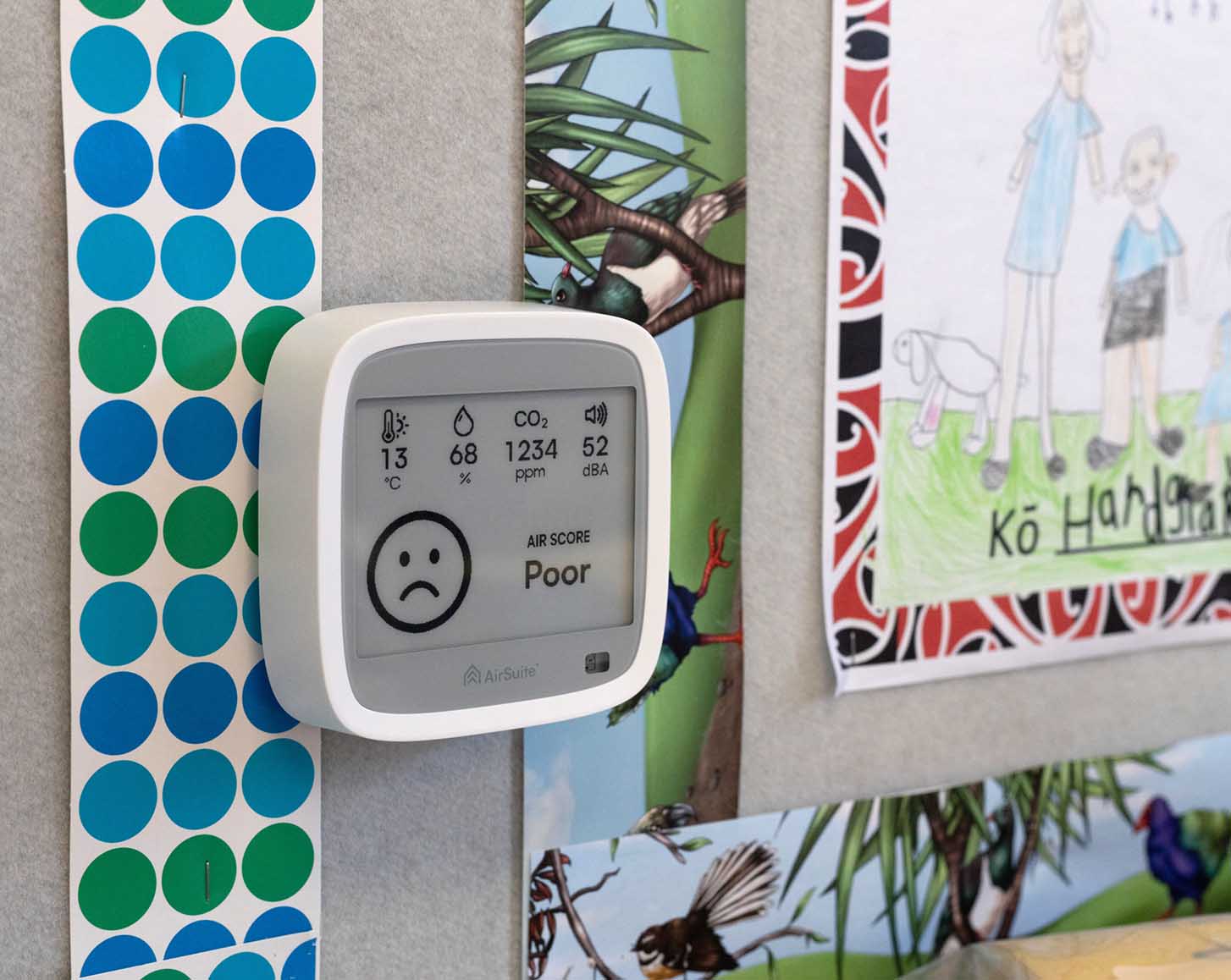
Monitors were deployed in general teaching spaces to record CO₂ levels, temperature, humidity, and lighting — factors that influence the students’ comfort and cognitive performance. Elevated CO₂ or temperature, for instance, can reduce focus and contribute to fatigue. The data helped identify opportunities to adjust ventilation or air conditioning to meet Ministry of Education (MoE) recommendations for classroom air quality.
2. Engineering and trades workshops
As a network of technical colleges, Te Pūkenga includes several high-risk training environments for students of automotive, fabrication, welding, plumbing, gas fitting, and carpentry. In these areas, AirSuite devices measured noise levels, particulate matter (PM), volatile organic compounds (VOCs), carbon monoxide (CO), carbon dioxide (CO₂), and temperature and humidity. These metrics aligned with WorkSafe New Zealand’s exposure standards and AS/NZS lighting guidelines for industrial environments.
When spikes occurred, staff were able to cross-reference readings with actual workshop activity — for example, detecting that particulate matter increases coincided with cleanup time, when students were sweeping their work areas. This enabled simple behavioural or procedural fixes, like switching from brooms to vacuum cleaners in some workshops.
3. Health, beauty, and veterinary training spaces
Wintec’s Urban Hair and Beauty salons were monitored for VOCs, humidity, and temperature — particularly during assessment periods that involved high levels of activities like colouring, perming, and waxing treatments. Similarly, veterinary nursing and animal technology spaces were assessed for air quality and lighting conditions within surgical areas where both staff and animals may be sensitive to airborne contaminants.
Across all sites, AirSuite monitors provided objective validation of subjective feedback. When tutors reported “stuffy” or “too cold” spaces, health and safety officers were able to install one of their portable AirSuite devices quickly to ascertain whether those perceptions reflected genuine environmental conditions.
In the words of Te Pūkenga’s Programme Lead, Craig Bulloch:
Now, when someone says it’s too stuffy or too cold, we can show exactly what’s happening. We’ve moved from opinion-based to evidence-based health and safety.
Craig Bulloch, Programme Lead, Te Pūkenga
Systematic deployment and benchmarking
Each region was given a set of five to six devices to share throughout their business divisions, on a rotating annual programme. The approach followed a structured two-phase model:
- Benchmarking phase — monitors were placed in representative spaces across each department to establish baseline conditions for key parameters. These benchmarks were informed by the Ministry of Education’s environmental quality guidelines for learning spaces and WorkSafe exposure standards for trade environments.
- Monitoring and re-assessment phase — devices continue to be redeployed periodically (every 6–12 months) to measure against benchmarks and assess the effectiveness of any interventions, such as upgraded extraction systems or lighting improvements.
For example, after elevated CO₂ readings were recorded in a veterinary nursing lab, ventilation changes were made, and the devices were returned six months later to confirm improvement. Similarly, woodworking areas were reassessed after maintenance upgrades to ensure particulate levels remained within safe limits.
This cyclical programme built a culture of proactive improvement. Tutors were directly involved in interpreting results — linking environmental data to teaching practices and maintenance routines. Importantly, this process reinstated “mana” to the wellbeing team by making safety visible and actionable, as staff and students alike understand that their feedback will be heard and actioned.
Outcomes: cost savings and wellbeing benefits
The financial return was immediate and tangible. The fleet of 36 AirSuite devices — costing roughly the equivalent of three consultant assessments — now supports environmental monitoring across 25 business divisions nationwide.
Beyond cost efficiency, the wellbeing impact has been profound:
- Objective reassurance for staff and students that spaces meet or exceed MoE and WorkSafe standards.
- Empowered decision-making for safety and facilities teams based on transparent data.
- Faster resolution of comfort complaints — from temperature and lighting to air freshness — reducing downtime and increasing satisfaction.
- Improved maintenance and housekeeping practices, such as timely filter changes and extraction checks.
- Positive student engagement, with environmental monitoring incorporated into safety inductions and open-day communications to demonstrate care for learners’ health.
It’s not about being reactive anymore. We can put the device in, see what’s happening, and make informed changes immediately. It gives everyone — from tutors to technicians — confidence that their environment is safe.
Craig Bulloch, Te Pūkenga
What the monitors were held to
Across all learning and workshop spaces, AirSuite devices continuously tracked parameters aligned with recognised health and safety guidelines.
| Parameter | Where it mattered | Benchmark |
|---|---|---|
| Carbon dioxide (CO₂) | Classroom ventilation and occupant comfort | ≤ 1,000 ppm (Ministry of Education, Designing Quality Learning Spaces — Indoor Air Quality, 2020) |
| Volatile organic compounds (VOCs) | Hair, beauty, and automotive environments | < 500 µg/m³ (no formal NZ limit; internal benchmark derived from WHO indoor-air guideline values) |
| Particulate matter (PM2.5 / PM10) | Woodworking, welding, fabrication | PM₂.₅ ≤ 25 µg/m³ (24-hour mean); PM₁₀ ≤ 50 µg/m³ (24-hour mean) — NZ Ambient Air Quality Standard, 2022 |
| Carbon monoxide (CO) | Automotive and gas-fitting bays | < 30 ppm (8-hour TWA — WorkSafe NZ Workplace Exposure Standard, 2023) |
| Temperature and relative humidity | All learning environments | 18–24 °C and 40–60% RH (MoE comfort guidance) |
| Noise level (dBA) | Engineering and fabrication | ≤ 85 dB(A) over an 8-hour TWA — WorkSafe NZ Noise in the Workplace Code of Practice |
| Illuminance (lux) | Classrooms, beauty, welding, veterinary spaces | 300–500 lux (classrooms), 1,000 lux (vet surgery), 150 lux (welding bay, per AS/NZS 1680) |
These values allowed each department to interpret AirSuite readings within a nationally recognised framework while also setting custom internal benchmarks to reflect the realities of different teaching environments.
Outcomes for Te Pūkenga
By adopting AirSuite’s continuous monitoring solution, Te Pūkenga demonstrated how tertiary institutions can safeguard staff and student wellbeing while achieving measurable operational savings. Through systematic benchmarking, alignment with national standards, and collaborative engagement, the initiative has become a model for proactive, data-led environmental management in education and beyond.
By implementing AirSuite’s system, Te Pūkenga has set new standards for the industry, and its students have seen best practice in action before they enter the workforce.