

Studies have shown that the acoustics, air quality and temperature of indoor environments can negatively affect students’ ability and willingness to learn.
This is what the New Zealand Ministry of Education’s bold indoor environment monitoring initiative, Te Haratau, aimed to address: improving the conditions in schools across the country to enable optimal learning outcomes.
Now monitoring over 8,000 New Zealand classrooms, Te Haratau is the largest indoor air quality monitoring project in the country.
But a project of this scale requires the right technology: it’s hard to know how, where and when to intervene — or even where money and time is best spent to get the most equitable results.
That’s why the Ministry of Education tapped AirSuite to provide bespoke solutions for schools, starting with our game-changing air quality monitor, AirSuite Glance LTE.
Read on to see why it’s the perfect solution for education.
1. Easy, quick, and cost-effective to install — access benefits within minutes
A beginner can install an AirSuite monitor in less than a minute. Seriously — we’ve seen it with our own eyes!
AirSuite sensors use cellular technology (4G/LTE) to connect to the mobile network, so you can deploy them anywhere, even without Wi-Fi on-site. We support a variety of mobile networks all over the world.
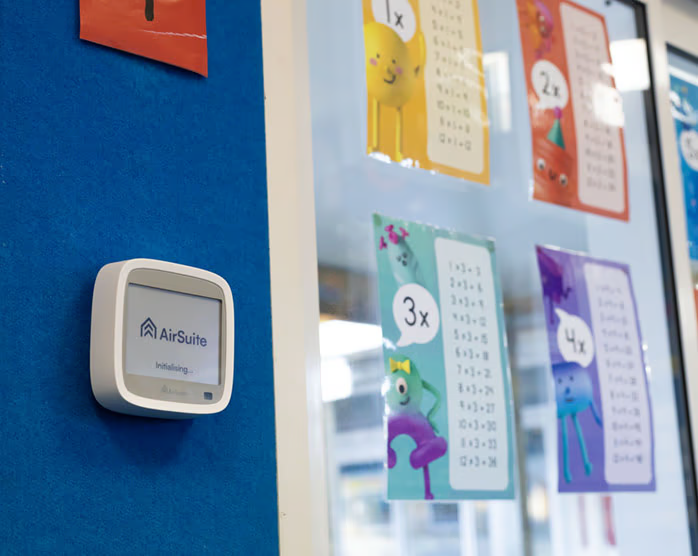
Each device is already set up with everything you need for your organisation. All you need to do is take it out of the box, put it on the wall, and your sensor will start transmitting to the Cloud immediately.
This makes the total cost of ownership much lower than other alternatives: there’s no need to contract an expensive third-party installer, and schools can start measuring their indoor environments immediately.
But best of all, it’s great for students, who reap the benefits of safer, healthier learning spaces.
2. Easy to evaluate data that drives powerful decisions
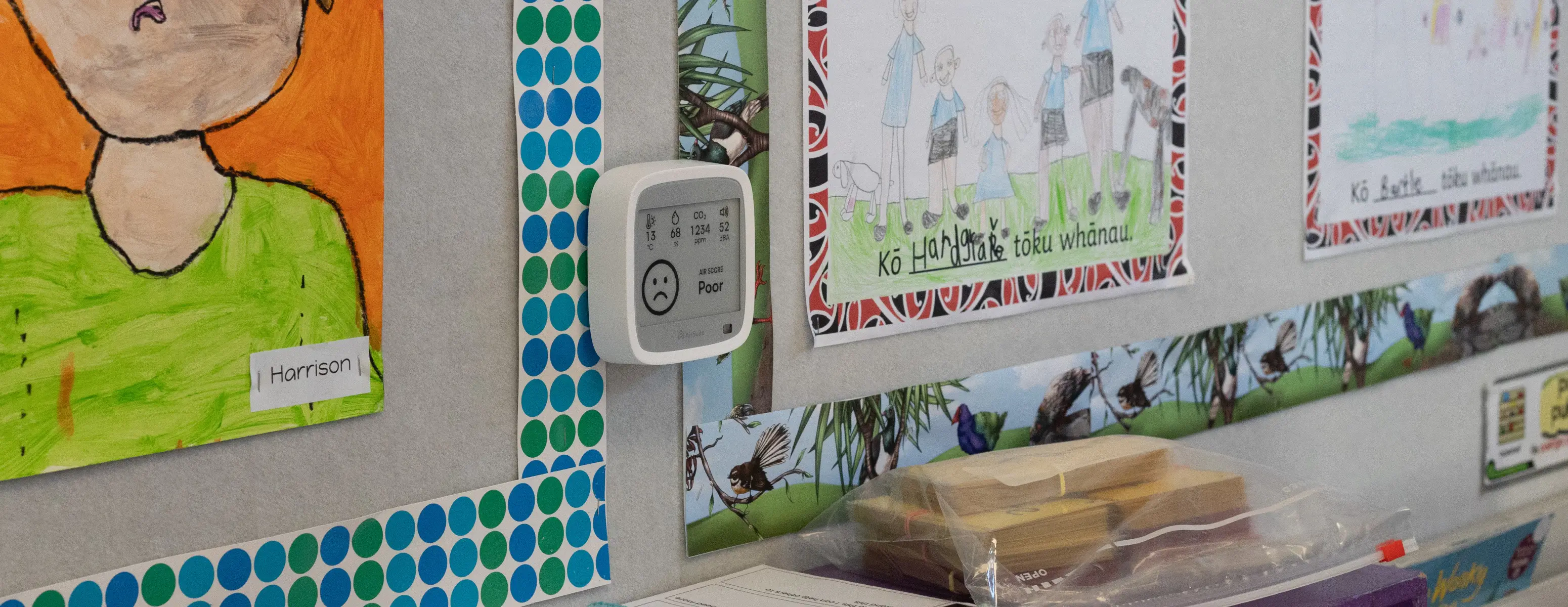
AirSuite also monitors CO₂ levels, which correspond to how well-ventilated a room is. Poor ventilation can reduce cognitive performance, and enables viruses like COVID-19 to spread more easily.
A study conducted by the Ministry of Education in 2022 confirmed the importance of monitoring CO₂ levels on a real-time display, available on AirSuite Glance:
With monitors showing CO₂ level and temperature, staff are checking the monitors as we walk past or glance at it when we are at the right place, and overall, we are quite happy about the CO₂ level for most of the day. When the CO₂ level gets higher, we actively open the windows to improve it.
Evaluation of Ventilation in Early Childhood Education and Care (ECEs) Centres — an analysis of 29 spaces at five ECEs in New Zealand
This quote demonstrates the power of having easy-to-interpret, at-a-glance data that is readily accessible 24/7. Staff and switched-on students can decide if opening windows will be enough to solve the problem and mitigate the risks, or they can escalate the problem to key decision makers, who can decide whether other interventions or refurbishment are required.
3. Easy to update remotely
While other market players need physical devices in their office to perform software updates, AirSuite do that remotely. This means they perform customer-led improvements with minimal disruption and downtime for clients.
4. Easy to monitor real-time data and historical trends for smarter decision making
Over the years, AirSuite monitors have recorded tens of billions of measurements from schools across New Zealand — and making sense of that data requires extremely powerful tools. AirSuite enables the Ministry of Education, as well as the schools themselves, to monitor classrooms in three ways:
- via the display panel on the sensor
- through a secure, Cloud-based Portal
- an app on any smart device.
With the AirSuite Portal, users can monitor what’s happening on the ground in real-time, and also analyse historical patterns.
For government agencies, the ability for analysts to access all the data from across the country in one place is a game changer in enabling them to make evidence-based decisions.
And if certain variables are about to reach uncomfortable or unsafe levels, a school staff member or teacher can be alerted on their phone or via email, so they can intervene immediately if necessary.
5. Easy to contextualise information for the big picture
A school at the top of the North Island will be very different to one at the bottom of the South Island! The AirSuite Portal includes various ways to compare schools based on their characteristics, including the region, climate zone, Equity Index (EQI), building age, roll size, and student age groups.
Discoveries from data have enabled schools and the Ministry to save millions of dollars by highlighting that some older buildings don’t need to be rebuilt to improve their indoor environmental quality — they only require an upgrade in glazing, for example.
6. Easy and cost-effective to run
AirSuite have been working with New Zealand’s Ministry of Education for several years and are always innovating our products and services to suit changing requirements. If you have a school that could benefit from AirSuite monitoring, remind them they don’t need to have a technical expert on-site to make it work.
7. Easy to compare sites for more equitable budgets
AirSuite devices all over the world capture tens of millions of data points on a daily basis, which are instantly uploaded to the Cloud and available for further analysis. If you’re a large organisation, maybe a government agency — with 10,000-plus devices spread across the country — you can instantly understand what’s happening across all facilities and make specific targeted decisions.
This is good news for parents and communities too — with the Ministry able to see which schools are not performing well in terms of indoor environmental quality, schools that could benefit the most from additional support are much more likely to receive it.